Private networks
A private network is an enterprise-dedicated network that provides communication connections to people, devices or things belonging to a specific enterprise and provides specific services necessary for the business of the enterprise.
The enterprise operates its own network and uses it exclusively. Unlike public networks, only allowed people and devices can access this network, and data generated within the enterprise is processed locally only with in the enterprise’s dedicated network, ensuring high security and data privacy.

5G involves a paradigm shift in the way of understanding mobile networks
That will allow the creation of a totally new ecosystem in which firms, corporations, the industry, public administrations, mobile operators… will be able to deploy their own private networks, personalized to fit their production and fabrication processes, services, use cases, applications…

The aim of 5G is to simplify private networks’ deployment and operation
JSC Ingenium pulls for the new networks and for participating in the construction of this new ecosystem, helping the industry in general and mobile operators to design, deploy and operate their own private networks, facilitating interoperability with other technologies deployed and new ones that are to come.
The new private networks based on Advanced 4G/LTE o 5G present large differences with respect to other technologies -Wired Ethernet, Wi-Fi…- that, in the case of industrial and entrepreneurial environments, are even bigger differences: secured coverages, capacity to operate a large number of devices and applications, bigger bandwidth, service quality and secured latencies -near real-time-, security, interoperability… and, of course, mobility.
“5G is a revolution that will allow the industry and operators to deploy their own private tailor-made networks”
4G/5G Opportunities

Full mobility

Highly reliable wireless and quality of wired grade

Strong security by SIM

Wide coverage

[ultra] High speed

[ultra] Low latency

Real-time service

[ultra] Connectivity

Guaranteed coverage

Traffic isolation

Data privacy

Different QoS

Geo-location indoor and outdoor
Benefits of Private Mobile Network

Offer flexibility of device movement and deployment efficiency.
Deliver required coverage and capacity with high quality and reliability through Ultra Reliable, Low-Latency Communications.

The enterprise has the means to determine how the mobile network is deployed for their specific situation.

Bandwidth can be delivered at scale to suit the needs of the enterprise without necessarily being dependent on the wider rollout plans of the public mobile network operator.
Control of persons, objects and devices in mobility: workers, external staff, mobile units, machinery, drones, AR/VR devices…
“Versus the limitations of an ethernet, enterprises can safely integrate with their employees, their mobile units…”
Advantages
The benefits of deploying private mobile networks based on LTE or 5G can include:
Security and data control
With full separation from wider public mobile networks.

Access to services
In locations not reached by public networks (improved coverage indoors, in remote areas, or in underground locations).
Flexibility
Mobile networks can be used in dynamic environments where equipment needs to move about and where fixed cabling either gets in the way or is costly to reconfigure or relocate.

Improved service quality
Where license-exempt technologies such as WiFi cannot meet an organization’s capacity, availability, latency, failover, or throughput requirements. Mobility and coverage are critical issues experienced by customers deploying WiFi networks.
Customization
Optimized network as for own services and use cases. The networks’ parameters can be configured (and reconfigured) to meet an organization’s exact specifications.

Integration
with wider public mobile networks where services are required outside the private campus or regional network (only realistically possible through roaming onto a public mobile operator’s network).

Multi-Technology Solution
5G SA/NSA, LTE, LTE-A, NB-IoT, LTE-M, LoRaWA.
Control
Government over data, specially most sensible ones (cyber security), and over the network.
There are several approaches to deploying private networks. Organizations can build and operate their own networks, buy solutions from equipment vendors or systems integrators, or even buy private LTE-as-a-service from a public mobile operator. They can be deployed as standalone networks, or integrated/ semi-integrated with existing public mobile operator networks. Some will build the network but outsource operation, maintenance, or support.
Markets
Campuses
- Campuses are universities, military bases, offices, other venues, and facilities where many people and IT systems across campus networks and indoors require capacity and density with fast and reliable Internet connectivity. A private mobile network can connect thousands of people and devices while eliminating fiber or cable deployments’ costs and challenges.
- Also, during 2020 and with the rise of Covid-19, students’ and workers’ access to their local schools, university or workplace has become a critical need of such Communities.With the rise of Covid it has become fundamental to provide access for the local community to school resources, especially for those students who lack Internet access.
Large public venues
- Large public venues, like Airports, Train Stations, Stadiums, and other Large Public Venues, often need strong coverage both inside their facility and outdoors to support the connectivity needs of their employees, devices and hundreds to thousands of visitors.
- Public networks are not typically configured to be able to meet the requirements of the high density of users or to deliver the new real-time or near real-time virtual and interactive services that can be offered at stadia or airports.
Public safety
- Today public safety networks are being deployed worldwide to deliver the real-time, mission-critical communication service that would enable emergency workers to save lives during disaster situations where even the public mobile networks are damaged or experiencing heavy loads.
Mine, oil & gas
- Private LTE and 5G Networks can provide the necessary coverage and reliability in connectivity needed for industry IoT applications and critical communication services that could connect any equipment used by Mine, Oil & Gas industries like drilling machines even underground.
Industry 4.0
- Industry 4.0 depends heavily on AR, VR, and AI-driven real-time data analysis to build smart manufacturing. It require high density, high capacity, low latency services, both indoors and across campuses, to support Industry 4.0 initiatives.
- Robots and factory automation require highly secure and reliable broadband wireless communications.
- The use of private LTE and 5G networks can help Manufacturing facilities to connect their manufacturing equipment to the IT facilities to deliver the to deliver the smart industry.
Health care
- High-density indoor environments with strict security requirements and massive AI-driven data analytic enable health care facilities to perform real-time patient monitoring, perform surgical operations remotely and securely.
Warehousing
- The Private Mobile network can help retailers and warehouse operators deploy automation of product inventory management and logistics to incorporate industry IoT robotic applications and AI-driven data analysis.
Utility
- The private LTE and 5G networks can provide nationwide secure, flexible, and reliable connectivity to Utility industries. And can help them adopt IoT applications like smart meters, energy storage systems, and other types of grid management solutions.
Product portfolio
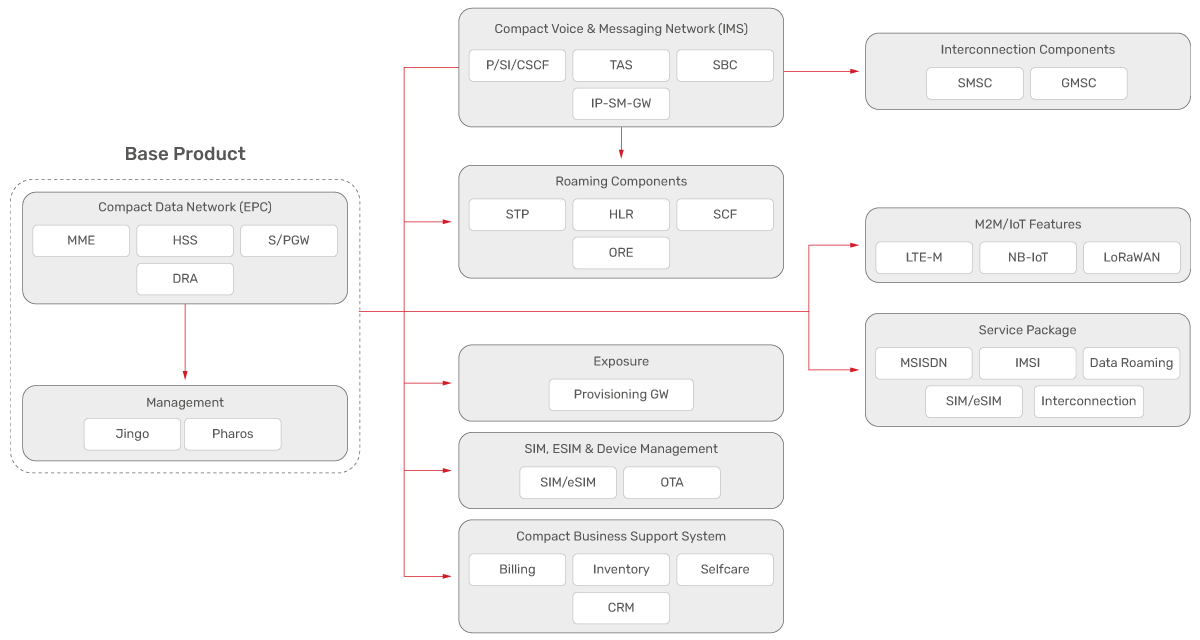
The Private Networks Portfolio is designed and built with the specific purpose of serving Industry and Mobile Operators and includes all the capabilities needed to provide private connectivity and communications services.
We live in an increasingly customized and personalized era. So, we have built our pick and choose portfolio, bearing in mind it will need to support Enterprises with different requirements, size, and setup. This means that we can fulfill virtually every demand of an enterprise, both at functional and integration levels, with minimized entry cost, adaptable feature set, flexibility to integrate to enterprise environments, and efficient operation.
The following diagram gives a functional view of the packages of Private Networks portfolio from JSC Ingenium:
“5G is a revolution that will allow the industry and operators to deploy their own private tailor-made networks”
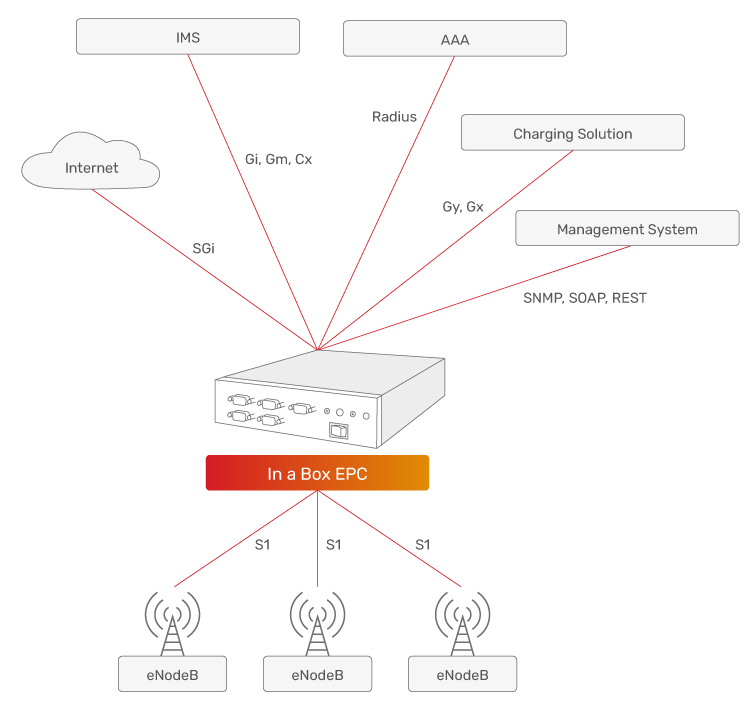
Deployment options
All EPC modules (HSS, SGW/PdnGW, MME) in as smaller footprint as possible, minimizing the investment of the enterprise.
Suitable for low traffic scenarios: Sensor network, limited employees.
Potential limitations
- Number of Physical interfaces and the need for aggregation in transport network.
- Maximum Throughput per node.
- Maximum Subscription per node.
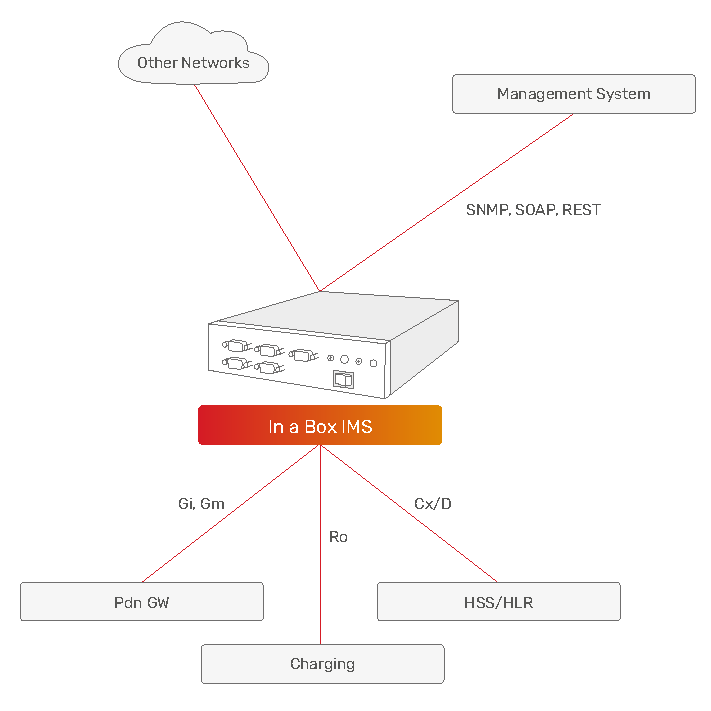
All IMS modules (P/I/S-CSCF, IP-SM-GW, SMSC TAS, SBC, MGCF) in as smaller footprint as possible, minimizing the investment of the enterprise.
Suitable for voice traffic used in offices and industries with limited voice users.
Potential limitations
- Number of Physical interfaces and the need for aggregation in transport network.
- Maximum Subscription per node.
- Enablement of Interconnection.
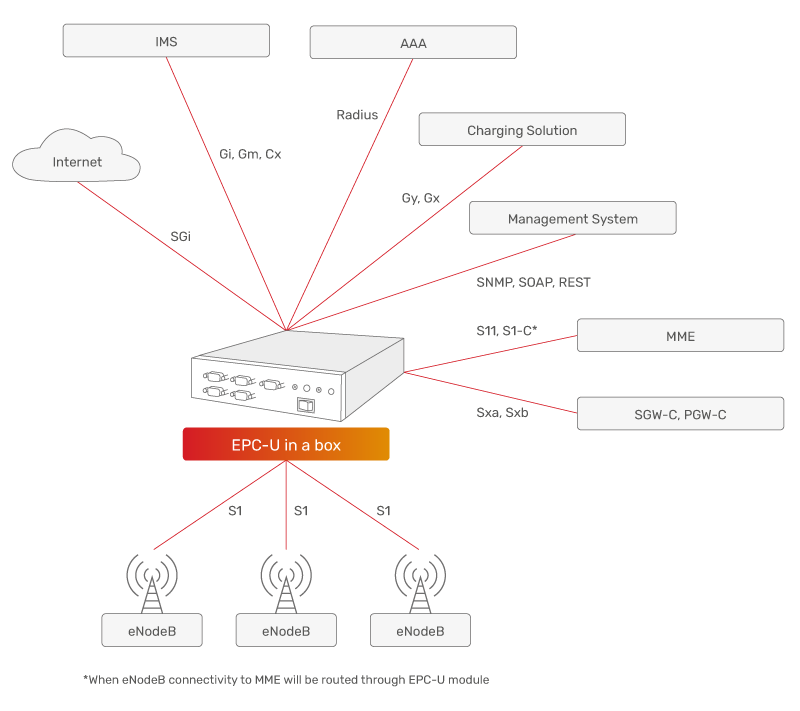
SGW-U and PGW-U (or complete SGW/PGW) in a compact but scalable form factor.
Suitable for distributed user plane where high traffic demand and low latency service needed.
Potential limitations
- Number of Physical interfaces and the need for aggregation in transport network.
- Maximum Throughput per node.
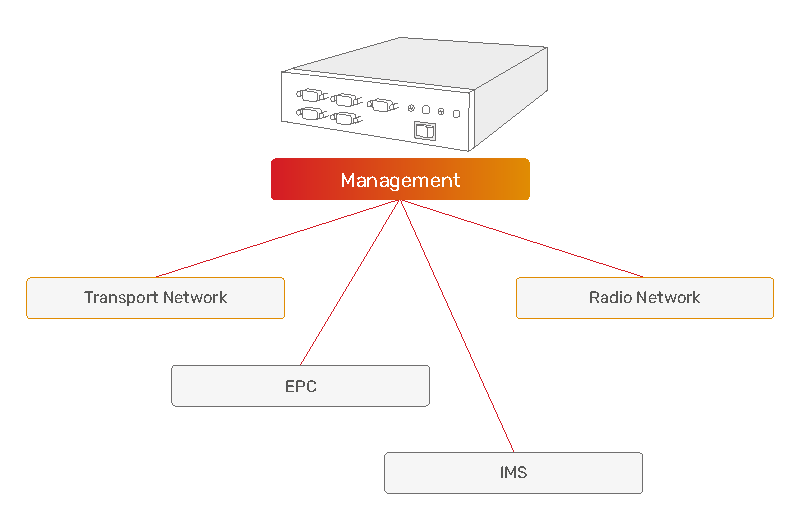
Jingo and Pharos, and any other necessary Management application.
Suitable for distributed user plane where high traffic demand and low latency service needed.
Potential limitations
- Number of Physical interfaces and the need for aggregation in transport network.
- Maximum Throughput per node.